

| |
| “Who but a stupid barbarian could burn so much beauty in his stove and destroy that which he cannot make?” Astrov asks Yelena in Anton Chekhov’s Uncle Vanya. “Man is endowed with reason and the power to create, so that he may increase that which has been given him, but until now he has not created, but demolished. The forests are disappearing, the rivers are running dry, the wildlife is exterminated, the climate is spoiled, and the earth becomes poorer and uglier every day. I see irony in your look; you don’t take what I am saying seriously, and—and—after all, it may very well be nonsense. But when I pass village forests that I have preserved from the ax, or hear the rustling of the young trees set out with my own hands, I feel as if I had had some small share in improving the climate, and that if mankind is happy a thousand years from now I’ll have been a little bit responsible for their happiness.” |
| Russia Devil of Destruction Anton Chekhov From Uncle Vanya. [Astrov: When I plant a little birch tree and then see it budding into young green and swaying in the wind, my heart swells with pride and I—I must be off. Probably it’s all nonsense, anyway. Goodbye. [Astrov and Sophia go into the house. Yelena and Voynitsky walk over to the terrace. Yelena: You have behaved shockingly again. Really, your behavior is too petty. Voynitsky: If you could only see your face, the way you move! Oh, how tedious your life must be, absolutely tedious. Yelena: It is tedious, yes, and boring! How well I understand your compassion! As Astrov said just now, see how you thoughtlessly destroy the forests, so that there will soon be none left. So you also destroy mankind, and soon loyalty and purity and self-sacrifice will have vanished with the woods. Why cannot you look calmly at a woman unless she is yours? Because, the doctor was right, you are all possessed by a devil of destruction; you have no mercy on the woods or the birds or on women or on one another.’ ] From 1897 to 2022. Reading what Astrov said, now in Australia in 2022, I give thanks for all who go on caring for the land. The Australian Conservation Foundation, The Wilderness Society, the Bob Brown Foundation in Tasmania, the Lock the Gate Alliance and the Australian Youth Climate Coalition, all those fighting for marine life and the people of good will supporting them with donations. We must support them every way we can. They are having to fight against a Coalition that prefers exploitation to conservation, short-term profit for fossil fuel corporations to long-term preservation of the environment for the future. And it has threatened to legislate against charities like these with loss of the right to tax deductions for being ‘activist’ in their protests. Now, when this President of Russia is destroying the lives of those in the democratic nation of Ukraine in his shocking, cruel unjustifiable, treacherous war. He guaranteed the sovereignty of the democratic nation of Ukraine but began this betrayal in 2014, it is time to remember the great Russians of the nineteenth century who spoke to Russia and later to us. There was Tolstoy’s War and Peace and, now, we have this excerpt from Uncle Vanya by Chekhov brought to us in Lapham’s Quarterly of Spring 2016 ‘Disaster’. Lewis Lapham takes us through history and all the warnings we ignored. See Lapham’s Quarterly, Volume XII, Number 4, – FALL, 2019 – ‘Climate’! But ‘Down Under’ – even while we send support to Ukraine – In Australia in 2022, with a national election due in four weeks, I am glad Lewis Lapham, a wonderful American trying to help us to think about the world we are creating, is reminding us about the fears Chekhov shared in his play about another longer-term form of destruction. We have one man standing for parliament here saying we might not even need to stick to zero emissions by 2050! And we have another man shouting how much money fossil fuel corporations will make in the EU! This Coalition will help them, with subsidies, exploit the devastation and the agony in Ukraine by selling coal and LNG to energy-hungry EU nations! |
Author: Erica Jolly
Worrying news from Canada.
Cosmos » Medicine » Living near fracking sites may have negative effects on pregnancies
6 April 2022 / ‘Cosmos’ is published by the Royal Institution Australia – the RiAus, with its headquarters in Adelaide. Those pushing for fracking in northern Australia should take note of this Canadian Report, The Australian Coalition government is putting our revenue into Empire Energy which is involved in this fracking project. Empire Energy appears to have a history, in USA, of lacking concern for the environment.
Living near fracking sites may have negative effects on pregnancies
Higher risk of congenital abnormalities and preterm birth linked to fracking wells in Canada.

A new study by Canadian researchers has reported links between adverse pregnancy outcomes and living near fracking sites.
What is fracking?
Hydraulic fracturing, or fracking, is an unconventional method for extracting fossil fuels, such as oil and gas, from underground rock. The technique involves drilling deep wells and using a mixture of water, sand and chemicals to generate high pressures that create fractures in the rock, through which oil and gas can escape to be harvested.
In Australia, fracking has been controversial for some time and has recently been back under the spotlight due to plans to frack for natural gas in the Northern Territory’s Beetaloo Basin and for oil in the Kimberley in Western Australia. The proposal to frack in the Beetaloo Basin is currently the subject of a Senate inquiry.
Proponents of fracking plans point to expected economic benefits. But experts have repeatedly raised concerns about the effect of continuing fossil fuel exploration and development on Australia’s ability to meet targets to reduce carbon emissions and avoid catastrophic climate change. Opponents have cited further concerns about water contamination, the potential to trigger earthquakes, and damage to Indigenous cultural sites and practices. The health risks of fracking are also an area of active research.
Read more: What does science say about fracking?
What did the new study find?
The new Canadian study examined data collected between 2013 and 2018 from more than 34,000 pregnancies in rural areas of the province of Alberta.
The researchers found a significantly higher incidence of congenital anomalies (adjusted risk ratio of 1.31) and babies who were small for their gestational age (adjusted risk ratio of 1.12) born to mothers who lived within 10 kilometres of at least one fracking well. These results were supported after adjusting for several other factors, including parental age, multiple births, foetal sex, obstetric comorbidities, and the socioeconomic status of the area where the family lived.
For those living in areas within 10km of 100 or more fracking wells, the risk of spontaneous preterm birth was also significantly elevated (adjusted risk ratio of 1.64).
The authors wrote that previous studies from the United States had found associations between proximity to fracking sites during pregnancy, and increases in preterm birth and low birth weight. Do you remember Dick Cheney supporting fracking in USA, and the pictures of flames from fracking sites in national parks?
While the study design could not determine whether the adverse pregnancy outcomes were directly caused by fracking, the research team proposed several potential mechanisms that could explain the relationship. These included groundwater contamination and changes in air quality due to fracking, as well as reproductive toxicity of chemicals present in the fracking fluids that are pumped underground.
“This study from Alberta, Canada, raises some potentially very important concerns about the possible environmental risks for women who live close to fracking sites,” says David Ellwood, a professor of obstetrics and gynaecology at Australia’s Griffith University, who was not involved in the study.
“The increased risk for babies of major congenital anomalies, and being small for gestational age, suggests an effect in pregnancy that is there from the outset and may be mediated through placental function.
“With larger numbers it is possible that other effects could be seen which are mediated via placental dysfunction such as stillbirth.”
Are there any implications for fracking proposals in Australia?
Alex Polyakov, an associate professor in medicine at the University of Melbourne, cautioned that the results may have limited application to Australian contexts.
“The risk of adverse outcomes was only significantly elevated for women who were exposed to a large number of fracking sites for significant periods of time,” says Polyakov.
“In Australia, fracking is not nearly as widespread as it appears to be in Canada. Most fracking shafts are also situated in sparsely populated locations, and it would be highly unusual to find multiple fracking sites in close proximity to residential areas, even in the rural setting.”
However, it doesn’t follow that these risks should be taken any less seriously, particularly when the population at risk already experiences health disparities. For example, the area around the Beetaloo Basin is home to several towns and communities with a large Indigenous population.
“Given the seriousness of these findings, it is important to try and replicate this work in other settings,” says Ellwood.
Originally published by Cosmos as Living near fracking sites may have negative effects on pregnancies
From worrying news to good news.
Solar power in Mexico.
Mexico built a #solar farm to power 1.3 million homes setting a world record by installing 18,990 #solarpanels in a single day.
We have solutions to the #climatecrisis. The only thing missing is the political will to implement them.
#ActOnClimate #climate #renewables
Solar and hydrogen
Energy security
For small communities
The French Company HDF.
working with the Cape York Institute
has this project ready for French Guiana.
The world’s first baseload renewable energy power …!
Long term employment for Cape York
and Thursday Island in the Torres Strait.
Possible before 2030 – for these Indigenous communities!
Listen to all of this – only 13 minutes
The Science Show
with Robyn Williams


Play
Space to play or pause, M to mute, left and right arrows to seek, up and down arrows for volume.
Listen
Hydrogen coming for Cape York communities
On The Science Show with Robyn Williams
Share
Download Hydrogen coming for Cape York communities (18.89 MB)
Download 18.89 MB
A challenge for remote communities with small populations and large distances to major centres is developing viable industries with secure well-paid jobs. Now, it seems, renewable energy and hydrogen power promise to solve many problems in one hit. Currently, remote communities rely on highly polluting diesel to run generators, and to run transport. But throughout Cape York, roads can be cut for weeks or longer during the wet season jeopardising supply. David Thompson, from the Cape York Institute in Cairns describes a bold plan to replace diesel with renewables and hydrogen in Cape York communities. Benefits include, reducing emissions to zero, keeping money in the local community, driving down costs, and providing employment for local people. The plan has support from power companies and government agencies and brings hope to remote communities across the top end.
Guest
David Thompson
Project Lead – Policy
Cape York Institute
Cairns Qld
Reporter
Carl Smith
Presenter
Robyn Williams
Duration: 13min 45sec
Broadcast: Sat 5 Mar 2022, 12:02pm
Transcript
HYDROGENE DE FRANCE – HDF Energy Breaks Ground on …
https://www.actusnews.com › … › Mois 09 › Jour 29
First Nations determined to think outside fossil fuel – diesel – for their communities,
But this Australian Coalition is still only interested in 2050. A terrible decision.
That damnable doubt machine.

Cecilia Tomori (John Hopkins University)
Scientists: don’t feed the doubt machine.
On the ABC Radio National – The Science Show with Robyn Williams
Share
Download Scientists: don’t feed the doubt machine (21.32 MB)
Download 21.32 MB
Cecilia Tomori grew tired of lies and distortions which too often swirl around as scientists seek the truth. The doubt machine has been around for years. The strategies and patterns have been documented and recur across industries such as tobacco, fossil fuels, pharmaceuticals, food and more. Tomori has come up against the doubt machine in her own work in false claims that undermine breastfeeding to increase sales of formula milk. Recently we’ve all seen the doubt machine in full light, cranking out falsehoods in climate science, and now with the COVID pandemic, including assertions about ‘herd immunity’. Cecilia Tomori thinks scientists can do more, taking more care with how they present certain arguments in public. So she wrote a plea to scientists, published in Nature.
Scientists: don’t feed the doubt machine – Nature 2nd November 2021
Guest
Cecilia Tomori
Associate Professor
John Hopkins School of Nursing
Director of Global Public Health and Community Health
Bloomberg School of Public Health
Johns Hopkins University
Baltimore, Maryland USA
- Share
- Latest
Support Science Journalism
REmember ‘The Merchants of Doubt’ . Remember Marian Wilkinson’s ‘Carbon Club’.
Big oil all talk, no action on climate change? Researchers say they’ve got the proof
The world’s highest-polluting oil companies such as Shell, ExxonMobil, and BP are promising big but delivering very little on climate change, according to damning new research.
And there is so much reason for us to be angry about their actions and their inactions. They will do what the loop holes in laws will let them get away with. And too often backed by governments and subsidized by us.
Note this article by Peter Milne for the journal Boiling Cold,
About decommissioning and the costs of insufficient regulation for the nation’s future
WA onshore and coastal oil & gas clean up to cost billions

Santos and Chevron, through Varanus and Barrow Islands, have a big part to play in the clean up of 1000 oil and gas wells in WA, with about 300 ready to be plugged now
Peter Milne
Sep 1, 2021 • 5 min read
And now Woodside is being supported by the Federal Coalition government to develop a LNG – really methane – project, the Scarborough Project in the sea off our NW coast.
Thank you Sinanen, this Japanese energy giant
Australian company, Sweetman, is ‘greenwashing’. It calls itself Sweetman Renewables – calls logging of our native forests for wood chip for electricity ‘biomass’.
Last year, Sweetman announced it planned to export 60,000 tonnes of woodchips from Newcastle to burn in Japanese power stations.
“Deplorable” — that’s how Japanese energy giant Sinanen described an attempt to tie it to a plan to burn Australian native forests in Japanese power stations.
Woodchip company Sweetman told the media they had signed contracts with Japanese energy companies, including Sinanen, to burn native forest “biomass” for electricity.
Working with Friends of the Earth Japan, the NSW Nature Conservation Council discovered that this claim was untrue and potentially misled investors and the public.
Sinanen chief executive Masaki Yamazaki wrote to the Nature Conservation Council stating:
“We don’t/will not have any contract with Sweetman on wood chips supply. We deplore the announcement that Sweetman had signed an agreement with us (Sinanen Holdings) to import wood chips.”
If that happened, the New South Wales North Coast forests would be flogged even harder, destroying the habitat of koalas, gliders, birds and other animals — all for a few minutes of electricity.
Sweetman calls itself ‘Sweetman Renewables’ ‘The company has closed a deal on the purchase of the 100-year-old sawmill business, all assets and real estate at the historic Millfield site in the NSW Hunter Valley.] Our Coalition government doesn’t seem to care.
Australia’s Coalition government is not willing to take Federal action to prevent extinction of plants and animals. Check how its Members of Parliament voted.
Thank heavens for watch dogs like the NSW Nature Conservation Council and the Friends of the Earth Japan and this international collaboration for our survival.
Japan’s goal to reduce emissions might not be sufficient but at least they do have a 2030 target for some areas. Australia had no 2030 target in the plan it took to Glasgow!


| Three cheers for our Nature Conservation Council investigating these claims. The Nature Conservation Council has referred Sweetman to the Australian Securities and Investment Commission, which is now assessing the company’s behaviour. We must make them aware of Sweetman’s destructive woodchipping plans. It’s a revelation that strikes at the heart of this deplorable industry, and will raise the attention of potential investors and the corporate regulator. Our investigations team are digging into Sweetman because if Sweetman’s plans succeed, it would drive a doubling of native forest logging in NSW. The Nature Conservation Council will continue to work with Australian and Japanese environmentalists to expose this proposal and ensure it never happens. We are targeting investors, authorities, customers, consumers and the public. Already, the Port of Newcastle, Sinanen, and the City of Newcastle have all distanced themselves from this destructive proposal |

Thank you to the Nature Conservation Council of NSW and Friends of the Earth Japan.
Friends of the Earth International, Secretariat, P.O.Box 19199, 1000 GD Amsterdam, The Netherlands, Phone +31 (0)20 6221369.
If only the Australian Coalition government would prepare the national environmental and biological diversity legislation required by the Graeme Samuel Report about the state of the ‘not fit for purpose’ 1999 -2000 legislation still conveniently being used by this pro fossil fuel government.
Thank heavens for these scientists
Their initiative – The Global Peace Dividend
Share their petition widely. It is here in so many languages.
Build a global fund to fight against climate change, pandemics and extreme poverty.
The 50 Nobelists’ appeal: spend less on the military, more on human welfare!

The Global Peace Dividend Initiative started this petition to Joseph R. Biden (President) and
русский | Français | हिन्दी | 中文 | Türkçe | Italiano | Español | Bahasa Indonesia | עִברִית | Deutsch | Português | 日本語 | عربى | Ελληνικά | Polski
In December 2021, over fifty Nobel laureates and presidents of learned societies signed an appeal for a “Global Peace Dividend”. Taking stock of the accelerating global arms race, they proposed that all member states of the United Nations negotiate a common 2% reduction of their yearly military expenditure. They also suggested that one-half of the resources saved by this reduction be allocated to a global fund to fight against climate change, pandemics, and extreme poverty.
In the period 2025-2030, the ‘peace dividend’ generated by the laureates’ proposal would exceed one trillion US dollars — an amount comparable to total investments in renewable power worldwide, and six times greater than the funds available to research and treat cancer, HIV/AIDS, TB and malaria combined.
In an era of mounting challenges to human welfare, these new resources could positively impact the lives of millions, at zero cost for nations.
We, the signatories of this petition, strongly support the Nobelists’ initiative and ask you, Messrs. Guterres, Biden, Johnson, Macron, Putin and Xi, to start negotiating such an agreement as soon as possible.
Albert Einstein noted that one “cannot simultaneously prevent and prepare for war”. Today, leading intellectuals are laying out a path to prevent war and prepare for a prosperous common future. As Secretary-General of the United Nations and leaders of the permanent members of the UN Security Council, we ask you to take this path in our names.
—–
Please share this petition widely! It’s the best way to make change happen.
For more information about the #GlobalPeaceDividend, visit www.peace-dividend.org or follow us on social media:
- Twitter: @GlobalPeaceDivd
- Facebook: @GlobalPeaceDividend
- Instagram: @GlobalPeaceDividend
- LinkedIn: @GlobalPeaceDividend
Interesting. Australia is a founding member of the United Nations. Thank you Dr Evatt. But, in Australia the Australian national Coalition government is budgeting for $270 billion over a decade for armaments. In addition it is now to buy nuclear submarines from the UK and USA through what they call AUKUS. The Coalition’s Minister for Defence has just spent $3.5 billion on tanks. From 2013 Coalition governments cut billions from public health and adopted a policy of ‘Trade. Not Aid’ and decreased to the lowest level their contribution to foreign aid, while talking about ‘our Pacific family’.
Australians, however, might have more foresight than their Federal government and share and sign this petition and let their Members of Parliament know how they feel about its current military priorities, particularly now we see the impact on Tonga and across the Pacific of that underwater volcanic eruption and the tsunami that has come with it in the midst of this pandemic.
‘A most interesting and worthy initiative ‘(from ‘Nature’)
Meet Carlo Rovelli – quantum physicist connecting sciences and humanities. See his books.
He has done everything he can to get rid of what he calls the ‘pernicious modern’ separation of the sciences from the humanities. And his humanity and depth of understanding is here.

Matteo Smerlak | Facebook
https://www.facebook.com › matteo.smerlak
Put defence money into planetary emergencies, urge Nobel winners
The Global Peace Dividend initiative was launched last month by more than 50 Nobel laureates and the presidents of 5 major science academies.
It calls on all countries to jointly reduce military spending by 2% each year and instead contribute to a global fund to tackle climate change, pandemics and extreme poverty.
Theoretical physicists Carlo Rovelli and Matteo Smerlak, the organizers of the initiative, encourage more people to sign the petition here: peace-dividend.org.
How about Climate Action Teams!
Look at climate teams of nations.
Take in the examples given in Cosmos.
‘Cosmos’ – the weekly journal of RiAUS
This is the Royal Institution of Australia.
connected with the Royal Institution, London
based in Adelaide, in the Bragg Science Exchange.
Think of cross global connections for emissions reduction.
Look at the possibilities for Switzerland, New Zealand and Chile.
And the possibilities for Australia, Indonesia and PNG and/or South Africa.
See the proposal by the chief economist at the Environmental Defense Fund. [EDF]
Are Climate Action Teams the future of global emissions reductions?
/ 17 December 2021
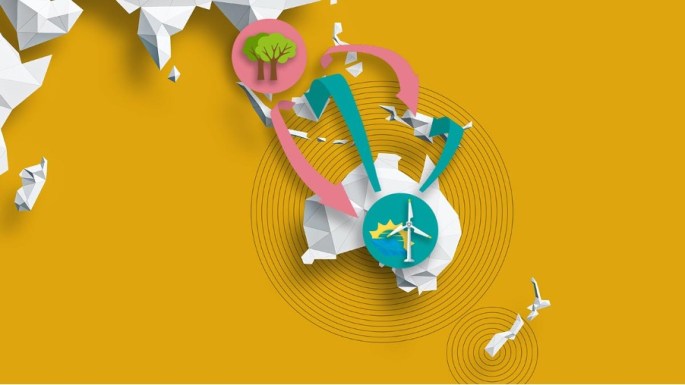
Illustration by Marc Blazewicz. Credit: Zbruch / Getty (map), Getty Images (vectors).
‘New research reveals the economic viability of developing and developed countries partnering to reach enhanced emissions reduction goals.
‘Chile, New Zealand and Switzerland may be half a world apart geographically, but researchers say they share many of the same challenges when it comes to reducing their carbon emissions.
From the opportunities of geothermal energy to the challenges facing the high-emitting dairy and forestry industries, to the need to consult and cooperate with local indigenous groups, these countries have more similarities than you might think.’
That’s why they have been chosen as an example of what could work under a new model of international carbon trading referred to by researchers as Climate Action Teams.
Suzi Kerr, chief economist at Environmental Defense Fund (EDF), says the Climate Action Teams model partners wealthier developed countries with developing countries to reduce emissions globally. It is about increasing ambitions at an affordable cost, and not about using the mechanism to replace or avoid domestic targets and objectives for net zero.
“By 2030, more than 70% of emissions will be in developing countries,” she says. “That means that the mitigation action that has to happen will be in developing countries.
“If we allow the wealthier countries to support and work with developing countries, and increase mitigation in the developing countries, through that support we can double the amount of mitigation for the same cost. So you can massively increase climate change ambition, making it much more likely that we will achieve our 1.5°C goal.”
What are Nationally Determined Contributions (NDCs)?
Nationally Determined Contributions are actions that individual countries have committed to take in order to achieve the goal of limiting global warming to below 2° Celsius, as part of the UN-led 2015 Paris Agreement.
Kerr says the teams would most likely be successful when the partnerships were between countries with similar industries and economies – to facilitate the sharing of policies, information and technology – or where there was an existing and historical relationship.
But she says both host (developing) and partnering (developed) countries would need to show a genuine and ongoing commitment to emissions reduction policies and frameworks for the plan to work.
“Chile already has quite an ambitious target – they would be mitigating beyond that, which would then put them on a path to be more ambitious,” she says.’
Suzi Kerr, EDF
One of the challenges would be to ensure that the price paid for emissions reduction in developing countries was fair and sustainable – not ridiculously low targets, but more sustainable long-term carbon emissions reductions based across whole sectors of the economy.
“Some countries are engaging in bilateral agreements with other countries where they are buying their low-hanging fruit – really cheap emission reductions,” says Ana Pueyo, a fellow at the New Zealand-based Motu Economic and Public Policy Research Institute.
“We would want them to collaborate in a climate team with a country that has a reasonably ambitious Nationally Determined Contributions (NDCs). And we would not be supporting them just to meet their NDC, we will be supporting them to go beyond.
“We will be talking about emission reductions over $50 per tonne, so not low-hanging fruit of the kind that we saw in the Kyoto Protocol that raised a lot of mistrust and criticism by environmental groups.
We want to collaborate with countries that are ambitious.”
What is the Kyoto Protocol?
The Kyoto Protocol was a UN agreement adopted in 1995 that committed industrialised countries to reduce greenhouse gas emissions in order to combat climate change. It has been largely superseded by the 2015 Paris Agreement.
Kerr says the proposal had a lot of potential in a country like Australia, where domestic politics around emissions reduction was messy and fraught with pushback from vested interests.
She says a Climate Action Teams model would enable a country like Australia to raise its ambition by partnering with neighbours like Papua New Guinea or Indonesia, or countries with similar economies and challenges like South Africa, and get a better return on investment when it came to reductions.
“Australia is going to really need to find ways to make real change without causing dramatic, politically impossible change in the Australian economy.”
Suzi Kerr, EDF
“Australia already has strong trade and aid relationships with Papua New Guinea and Indonesia, which would make them suitable candidates, or in South Africa you have many of the same challenges of large mining sectors trying to transition away from coal,” Kerr says.
“These natural affinities could be a really great thing because Australia is going to really need to find ways to make real change without causing dramatic, politically impossible change in the Australian economy. Australian climate policy has had a pretty rocky past, but this is the sort of opportunity to do something really good without having to fight the vested interests head on in the way some of the other policies might require.”
Kerr reports there has been lots of interest internationally. “Countries are really beginning to take their compliance seriously and they’re taking on much more ambitious, nationally determined contributions. They are also realising how difficult this is going to be.”
Originally published by Cosmos as Are Climate Action Teams the future of global emissions reductions?
While the people and governments around the globe focus on the virus,
the climate goes on changing.
AUKUS – Looked at a new way.
AUKUS is the trio formed for Australia to buy nuclear submarines from USA and the UK.
It appears we have much more in common than nuclear submarines.
Each of us faces the undermining of our environments in the name of market forces.
The science warning us about the future meets the face of market-driven greed.
I know it is too long and many will not be concerned while we face the pandemic but. . .
In Australia we have governments, Federal and State, equating fossil fuel with the future. When they talk of the economy and energy they avoid talk of the environment.

| Stop Woodside Climate-Wrecking Gas Project Now! greenpeace.org.au |
Our Australian Federal government is backing the exploitation of pristine waters off the NW coast of Western Australia by Woodside which now contains part of what was BHP. It is called the Scarborough Project. The Australian Coalition, a neo-liberal government, shown by its preference for privatisation and its now clearly market-driven approach to the pandemic, is undermining national efforts to protect the environment, preferring separate deals with different States and Territories.
It still avoids establishing ‘fit for purpose’ National Environment and Biological Diversity legislation required by the Graeme Samuel’s Report on the 1999/2002 legislation.
In the United Kingdom, see how its Environmental Agency has been hamstrung steadily by governments. Read George Monbiot’s essay.
Fishy Business
The ease with which I registered my dead goldfish as a waste disposer shows how total regulatory collapse has opened the door to organised crime.
By George Monbiot, published in the Guardian 24th December 2021
It’s a tragic story, with a happy ending. Until I was seven, I had a goldfish called Algernon. He wasn’t the most exciting pet, but I was quite upset when I found him floating one morning on the surface of his little tank. This, or so I thought, was the end of a short and uneventful existence.
But a few weeks ago, I wrote a column about the failure to regulate waste disposal in the UK. It showed how millions of tonnes of waste, some of it extremely hazardous, are now being handled by organised criminal networks, and illegally dumped or burned, presenting major hazards to our health and to the living world. It showed how the Environment Agency in England and its equivalents in the rest of the UK have lost control, to the extent that anyone can now get themselves officially licensed as a waste disposer, using false information that can remain unchecked.
Some people found this hard to believe. But as chance would have it, at that very moment, the spirit of my dead goldfish spoke to me. With a clarity he had never exhibited in life, he explained that he wished to be registered as an upper-tier carrier, broker and dealer in waste. This would ensure that anyone paying him to dispose of waste materials could be confident that he had met the requisite standards, and was not the kind of fishy operator who would take your money, dump your waste illegally, evade landfill tax and potentially land you, the unwitting householder, with a £5,000 fine for failing to exercise your “duty of care”.
Perhaps motivated by a sense of guilt, as I had neglected him in life, I sought to fulfil his wishes. On the Environment Agency’s website, I affirmed that he was a, ahem, sole trader and had no unspent convictions. I gave his name as Algernon Goldfish, of 49 Fishtank Close, Ohlooka Castle, Derby, and paid the requisite fee. It took less than four minutes. A month on, my long-deceased goldfish remains on the register as a bona fide upper-tier waste dealer. If you want your rubbish safely removed, no job too big or too small, Algernon is your man. Or your fish.
Already, in other words, the system has fallen apart. The government says, “We have pledged to reform the licensing system for waste carriers”, but this has been going on for a long time, and the situation is likely to get worse. Last month, the Environment Agency circulated two memos to its managers. They explained that while reports of pollution, illegal dumping and other kinds of damage are rising, grants for incident management have been reduced in real terms “by 90% in 10 years”. The only events to which it can still respond are those it is specifically funded to investigate, which means incidents at “regulated sites” (such as places handling radioactive waste, certain kinds of illegal waste and those involved in flood control) and water companies.
The memos instructed staff to “not routinely spend time” on anything other than acute catastrophes caused by other businesses. Members of the public reporting incidents at unregulated sites should be “reassured that their report is useful to help us prioritise our work”, and are effectively advised to take the law into their own hands, by speaking directly to the perpetrator. The agency’s officers are then instructed to “shut down report”.
In other words, unless you run a regulated site or are a water company, you can do what you damn well like. Mind you, as a constant stream of filth suggests, if you are a water company or a regulated site you can also do what you damn well like. Everything is fishy now, except our rivers.
There are two categories of crime in this country: those for which you can expect to be prosecuted, and those for which you can’t. There’s no consistent connection between the seriousness of the crime and the likelihood of prosecution. Bag snatchers stealing a couple of hundred pounds a week are more likely to be caught and charged than fraudsters emptying the bank accounts of elderly people. Carrying a few grams of cannabis is more likely to land you in trouble than dumping hundreds of tonnes of hazardous waste.
On one estimate, aside from the fake companies registered on the Environment Agency site, there are more than 250,000 unlicensed (in other words outright illegal) waste disposers in the UK. The number of con artists involved in ripping off vulnerable people and in white-collar fraud must also be high. According to the latest report by the auditors Crowe UK and the University of Portsmouth, in 2020 fraud cost people and businesses in the UK £137bn. Their estimate has risen by 88% since 2007. Yet only 0.4% of fraud is believed to result in a criminal sanction.
Many tens of thousands of people are likely to be involved in the industrial-scale money laundering, tax evasion, shell companies, corrupt practice and concealment of assets in the City of London and its satellites, and the UK’s property market. Large numbers are running coercive labour rackets in farming, car washes, nail bars, restaurants and other businesses. Altogether, it would not be surprising if more than a million people in the UK were engaged in the kind of organised crime that seldom leads to prosecution.
This is what you get from 40 years of deregulation. While good citizens are bound by ever more oppressive laws, “the market”, according to neoliberal theory, should be released from regulatory constraint. Deregulation is a euphemism for destroying the effective capacity of the state to protect us from chancers, conmen and criminals. Empowered to cut corners, fishy businesses outcompete responsible ones and we begin to shift towards an organised crime economy.
As crime syndicates extend their reach and expand their wealth, they become politically powerful. Eventually, mafias become embedded in public life. This is what happened in the US during prohibition. You can see it at work today in Russia, Italy, Mexico and Lebanon. There is no obvious mechanism to prevent it from happening here.
When Steve Bannon, Donald Trump’s chief strategist, announced that his aim was “the deconstruction of the administrative state”, people were horrified. But in reality, it has been happening for years, on both sides of the Atlantic. It’s just that they do it subtly. Our government couldn’t simply close down the Environment Agency: people would be up in arms. Instead, it hacks the budget and creates an institutional culture of demoralisation and failure. The same goes for the other regulatory bodies. Probity, integrity, trust? They sleep with the fishes.
Posted in health & safety, law & order
And in the United States of America the Environmental Protection Agency was trashed by Trump. But this, from the Center for Biological Diversity, refers to the US Fish and Wildlife Service.

Share to FacebookShare to TwitterShare to PrintShare to More
For Immediate Release, January 3, 2022
| Contact: | Noah Greenwald, (503) 484-7495, ngreenwald@biologicaldiversity.org |
Lawsuit Launched to Protect Tucson Shovel-Nosed Snakes Under Endangered Species Act
Rare, Beautiful Snake Wrongly Denied Protection
TUCSON, Ariz.— The Center for Biological Diversity filed a formal notice today of its intent to sue the U.S. Fish and Wildlife Service for once again denying protection to Tucson shovel-nosed snakes under the Endangered Species Act. In response to a September 2020 petition from the Center, the Service denied protection to the species for the second time in September 2021.
“The lovely Tucson shovel-nosed snake needs protection from massive urban sprawl from Phoenix and Tucson,” said Noah Greenwald, endangered species director at the Center. “Protecting this snake will mean protecting more of the natural desert we all love.”
The Center first petitioned for protection of the snake in 2004. In response, the Service found the snake warranted endangered species protection in 2010 but said such protections were precluded by its work to protect other species. In 2014 the agency reversed course and found the snake didn’t warrant protection. In doing so, however, it misinterpreted a genetics study to find the snake had a much larger range than previously thought and therefore didn’t need protection. That conclusion was directly refuted in a letter from the preeminent expert on the snake, the late Phil Rosen, Ph.D. In denying protection once more in September, the Service ignored this new information.
“The U.S. Fish and Wildlife Service is badly in need of reform, but so far we haven’t seen any effort to do so by the Biden administration,” said Greenwald. “It’s not just this little snake that has been wrongly denied protection. Over the years the agency has refused to list dozens of species protections despite clear imperilment, including wolverines and pygmy owls. Even when the agency does protect species, it often takes far too long, sometimes more than a decade.”
The striking Tucson shovel-nosed snake is characterized by alternating black-and-red stripes over its cream-colored body. It has a small range limited to portions of Pima, Pinal and Maricopa counties in an area sometimes referred to as the “Sun Corridor Megapolitan” for its rapid urbanization. Making matters worse, the snake only occurs on flat valley bottoms that are prime development areas.
Like other shovel-nosed snakes, the Tucson shovel-nosed snake is uniquely adapted to swim through sandy soils using its spade-shaped snout. According to a study by Rosen and Center Senior Scientist Curt Bradley, the snake has already lost 39% of its historic habitat to agriculture and urban development; the vast majority of its remaining habitat is unprotected and vulnerable.
Tucson shovel-nosed snake. Photo courtesy of USGS. Image is available for media use.
The Center for Biological Diversity is a national, nonprofit conservation organization with more than 1.7 million members and online activists dedicated to the protection of endangered species and wild places.

It is all symptomatic of what is happening in three basically English-speaking nations.
Forests are not fuel
Not just Bolsonaro in Brazil.
Time to go to the New Testament –
Matthew 7:3: ‘Why beholdest thou the mote that is in thy brother’s eye, but considerest not the beam that is in thy own eye?’
Time to look at this beam in Australia’s eye. What we will allow to happen to our bio-diversity! And this is just one instance of it. Consider the ‘green washing’ in the name.
Find out about this definitely mis-named Verdant Earth Technologies, established only 2018 since Morrison’s Australian Coalition fossil-fuel supporting government has held power.
Nothing will be lush, rich, flourishing, thriving, teeming, prolific after Verdant Earth Energy is finished with it in the name of ‘biomass’. And all the koalas will be gone.
‘Destroying forests to burn for a few minutes of electricity is not a climate solution, it is environmental vandalism and must not be allowed.’ See how big that beam in our eye is!
And Australia suffers from so many bushfires and they are worse and worse and we lose so much! And it is the beginning of our summer and there is a bushfire in Western Australia now! And a company expects to be allowed to do this!
Listen to the Nature Conservation Council on this video.
‘Biomass is not green energy’.
| WATCH AND SHARE THIS VIDEO ON REDBANK TO SPREAD THE WORD Watch on Youtube Share on Twitter Share on Facebook Verdant’s proposal, if approved, would require more wood than Forestry Corporation generates from its logging operations across the whole of NSW in an entire year. Verdant plans to source this timber from anywhere within 300km of Singleton, threatening forests all the way to Grafton in the north and the Illawarra in the south. If approved, Redbank will trigger the logging of thousands of hectares of our native forests each year. Biomass proposals like Redbank could set back forest protection and climate action by decades and must be rejected. Watch & Share Video LEARN MORE ABOUT THIS PROPOSAL Burning trees for electricity releases enormous amounts of carbon dioxide and feeds climate change. It takes a forest tree decades to grow but only seconds to burn in a power station furnace. The overall climate impact is arguably worse than coal, and the destruction of forests and all the animals that live there is devastating. Protecting native forests and the carbon they store is one of the solutions to climate change. |
I wonder how many ex-patriate Aussies care about what could be happening here.
We have a Minister for the Environment increasing the number of coal mines and wanting to reverse the decision of a Federal judge that she has a duty of care for children whose health suffers from ‘climate harm’ – asthma – from coal mines.
You have the right to vote in the next election.
A pack of playboys?
Our ABC RN Science Show
Privatising developments in space?
We have the right to be concerned.
A serious warning from the University of Adelaide’s
Professor of Ecology and Evolutionary Biology

Space travel and illegal wildlife trade are bringing greater biosecurity threats.
Fears of new biosecurity threats
Next – Australia’s new Chief Scientist presents her hopes for our possible contributions to the future with our public universities centre stage.
A reminder of the vital importance of Australia’s public universities that were left to languish by this Australian Coalition government in 2020 while COVID 19 raged.
Our public universities had to shed 40,000 positions. All that knowledge, acquired over years, lost. Lecturers, Tutors, Researchers, Librarians, Assistants had to find work elsewhere. They were not going to be funded to stay working for us.
Australia’s billions in revenue went to businesses and private schools, not to the knowledge and capacity of Australians to prepare for a future of global warming.
Hurrah for Cathy Foley – We must have the Humanities to ask the right questions.

Our chief scientist’s goals and hopes for science in 2030
Robyn Williams, presenter of our public ABC RN’s Science Show gives her the last words in today’s program – December 11th 2021.
This Chief Scientist from Australia’s CSIRO knows we need STEAM not just STEM.
When it is private fossil fuel wealth, not weather and the necessity to invest to adapt to changing climate and increased uncertainties – floods on the east coast, major bush fires on the west coast now in Australia’s early summer – that matters for those in government, in a democracy we can vote them out!
We are citizens not just tax payers.
 Sciences and Humanities